
Kamilah House
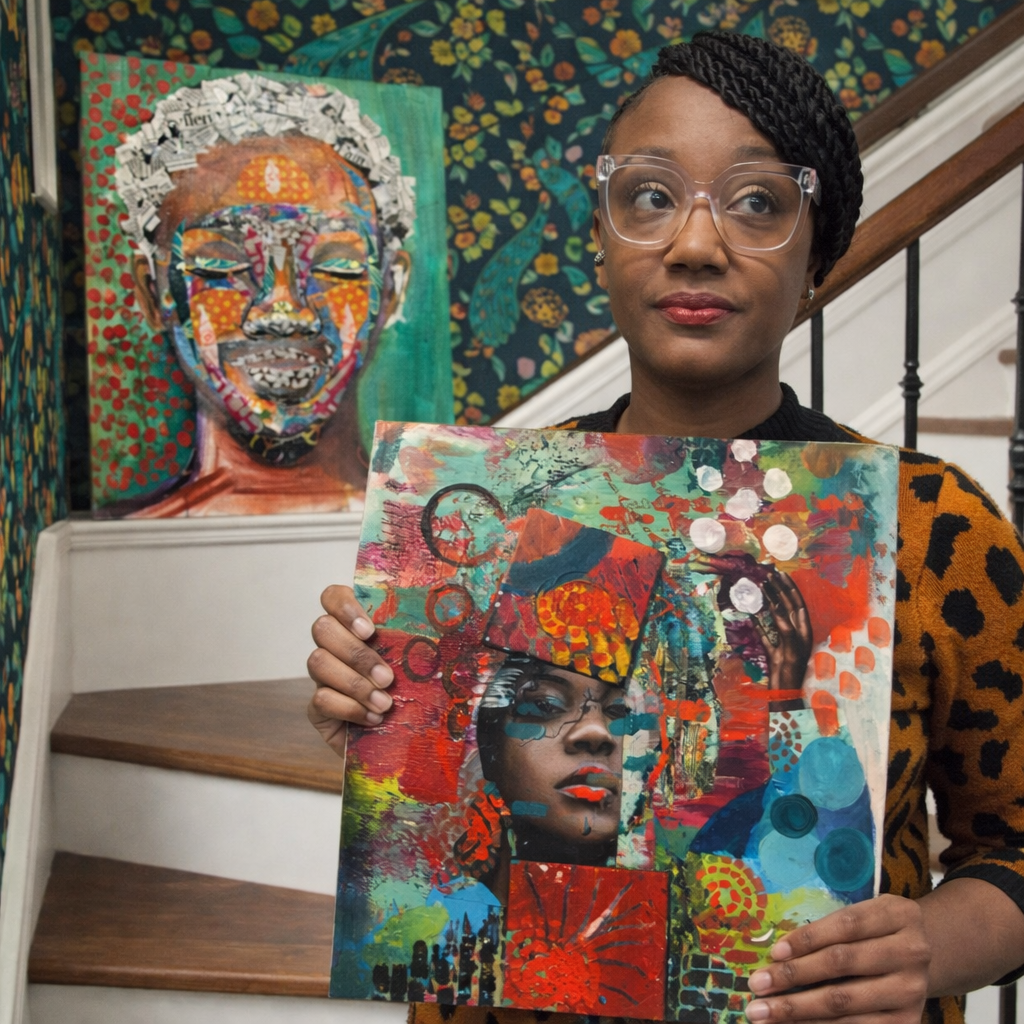
I am a Black woman. Bahamian and African American. A diplomat brat. An Emory graduate. A Madeira girl. I grew up in Prince George’s County, Nigeria, Algeria, Virginia, Illinois, and Iowa—moving across geographies that taught me how identity shifts depending on who is looking.
These works are about markets on both sides of the Atlantic. Open-air markets. Street vendors. Informal economies. Places where goods, stories, language, rhythm, and survival strategies circulate. Markets are not just commercial spaces—they are sites of negotiation, memory, improvisation, and power.
There is a river that runs through all of it. The Atlantic. Not just as water, but as inheritance. As rupture. As connection. As bloodstream. That river flows through our veins as members of the diaspora. It carried violence and extraction. It also carried music, foodways, faith, resistance, and the stubborn insistence on joy.
I work in mixed media collage because collage mirrors that history. Nothing arrives whole. It arrives fragmented, transported, traded, torn, renamed, reassembled. I layer paper, paint, texture, and pattern the way history layers itself onto the body. Some elements are visible; others are buried but still shaping the surface. That tension matters.
Markets, like collage, are about value. Who sets it. Who benefits. Who labors. Who survives. My work asks viewers to consider what is being exchanged—beyond goods. What stories are circulating? What histories are priced too low? What identities are misread at first glance?
These pieces hold both commerce and memory. Both movement and rootedness. Both loss and continuity.
The river is still moving. So are we.
Kamilah House, Self-Taught Artist.
Artist Statement
Kamilah O. House is a mixed media collage artist whose work sits at the intersection of art, politics, and cultural memory. Raised in an international, diplomatic environment, she brings a global lens to deeply personal narratives rooted in her Bahamian and African American heritage. Her collages layer paint, paper, pattern, and texture to reveal what power often attempts to obscure: the lived complexity behind public narratives.
House’s practice is unapologetically political—not partisan, but human. She uses fragmentation, repetition, and bold visual contrast to challenge stereotypes, interrogate systems, and honor Black life beyond reduction. Collage, for her, is not simply technique but argument—an intentional disruption of flat storytelling.
Through layered composition and symbolic imagery, House builds visual conversations that ask viewers to slow down, look closer, and reconsider what they think they know.
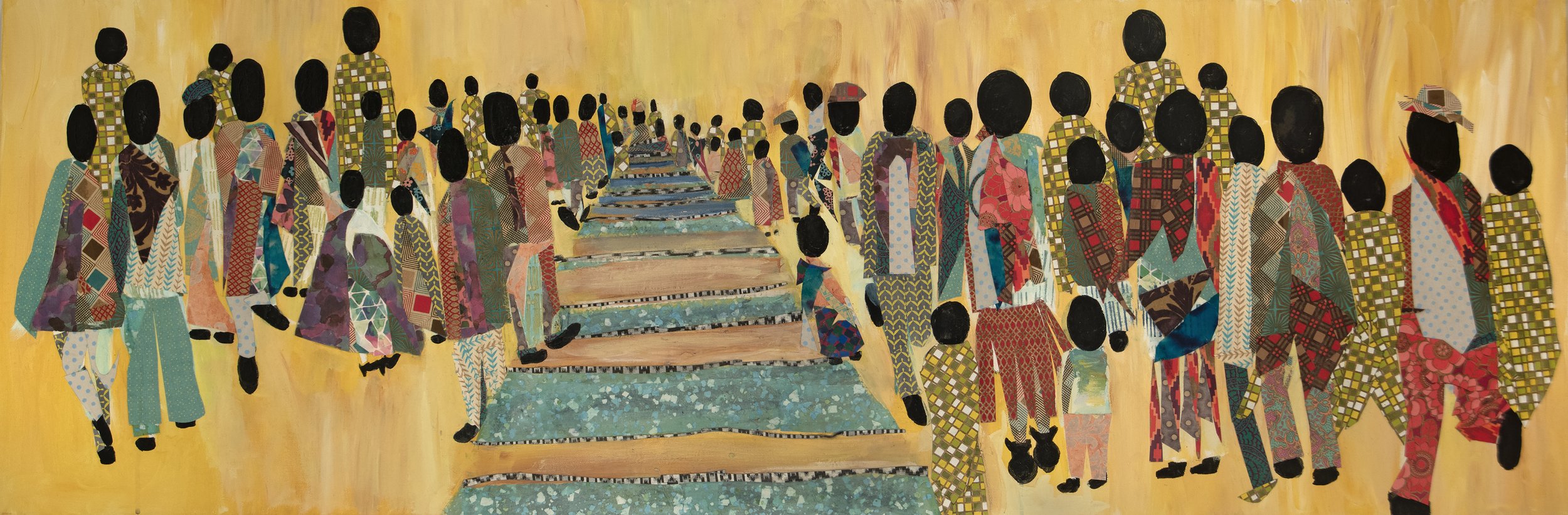
24” x 48” — Mixed Media in Canvas
Set against a luminous yellow background, this piece is about promise and refusal. Yellow here is not softness — it is sun, heat, gold, ascension. It speaks to the Middle Passage not as an ending, but as an imposed rupture that does not define finality.
The work rejects an end defined by others or by being othered. It reflects a belief in reunion — that a common history, a common soul, and ancestral memory bind people beyond separation. Even when stolen into what felt like hell, something remained intact. Blood remembers. Spirit recognizes spirit. What was scattered gathers again — if not in this life, then in the next.
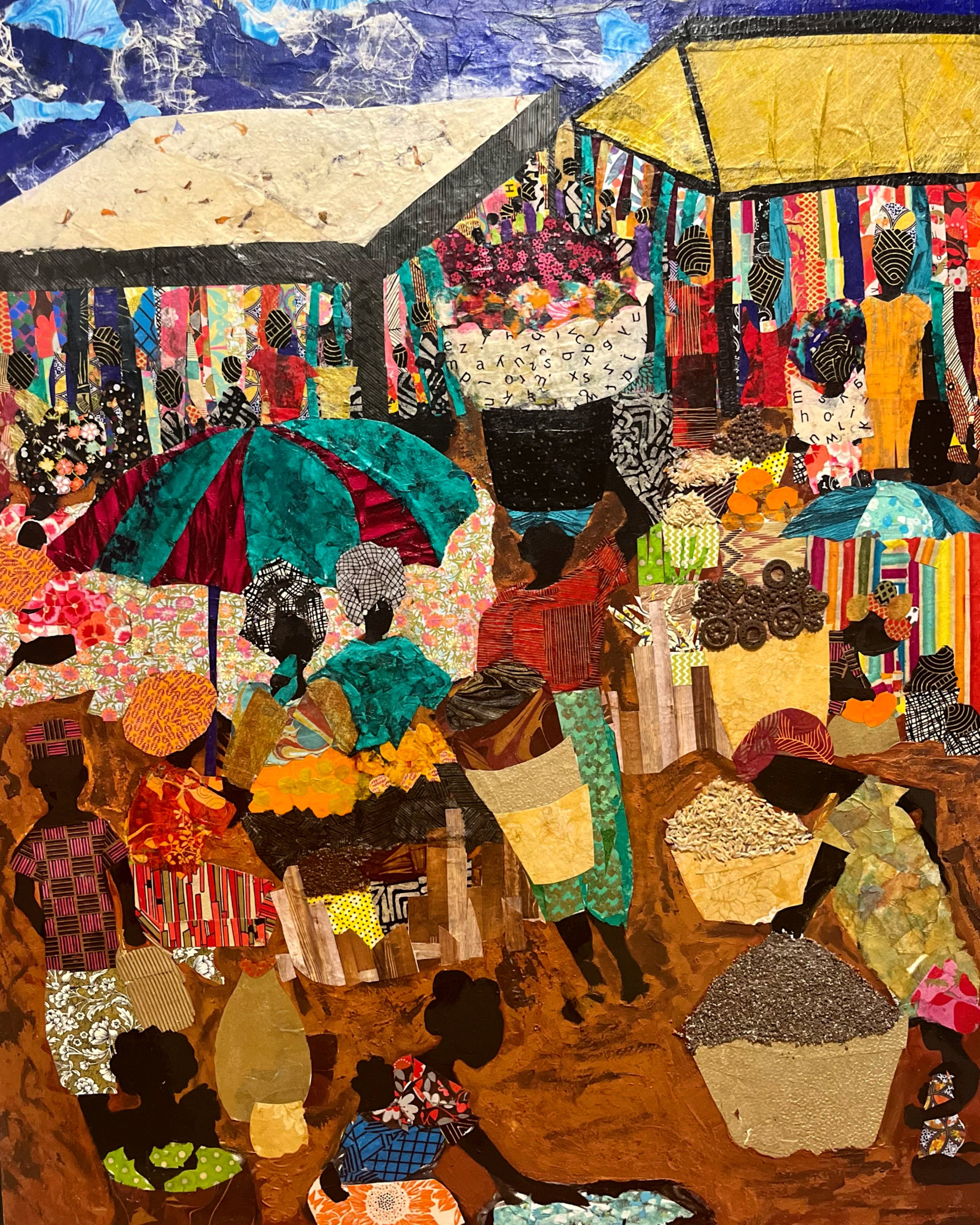
24” x 48” — Mixed Media in Canvas
Set against a luminous yellow background, this piece is about promise and refusal. Yellow here is not softness — it is sun, heat, gold, ascension. It speaks to the Middle Passage not as an ending, but as an imposed rupture that does not define finality.
The work rejects an end defined by others or by being othered. It reflects a belief in reunion — that a common history, a common soul, and ancestral memory bind people beyond separation. Even when stolen into what felt like hell, something remained intact. Blood remembers. Spirit recognizes spirit. What was scattered gathers again — if not in this life, then in the next.
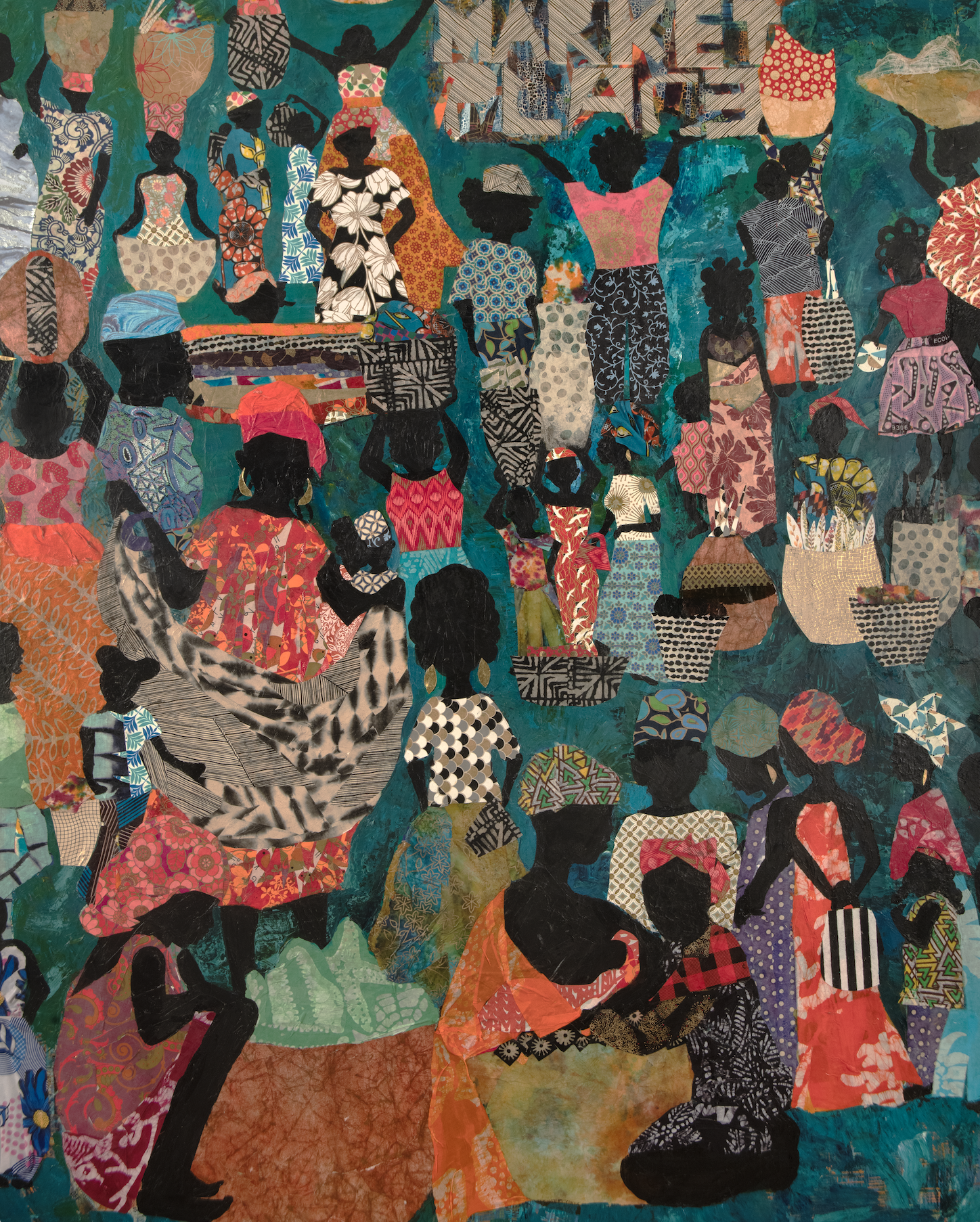
60” x 48” inches — Mixed Media in Canvas
This piece expands the idea of continuity through the lens of the Middle Passage. The title intentionally bends the spelling, signaling the word’s survival through diaspora. It reflects on what could not be stripped away: taste, adornment, sound, social structure, mutual aid, and spiritual frameworks.
The market becomes evidence. Not that markets are uniquely African, but that Black market culture in the diaspora carries recognizable West and Central African continuities in rhythm, structure, and social function. And it is broader than that- cultures throughout the so-called third-world share some of these elements. Even in displacement, people recreated a familiar system — a portable homeland. The painting speaks to resilience not as sentimentality, but as structural survival.